Emergency mouse bait permit (zinc phosphide 50 g/kg) – factsheet
Currently, parts of Australia are experiencing moderate to severe mouse plague conditions.
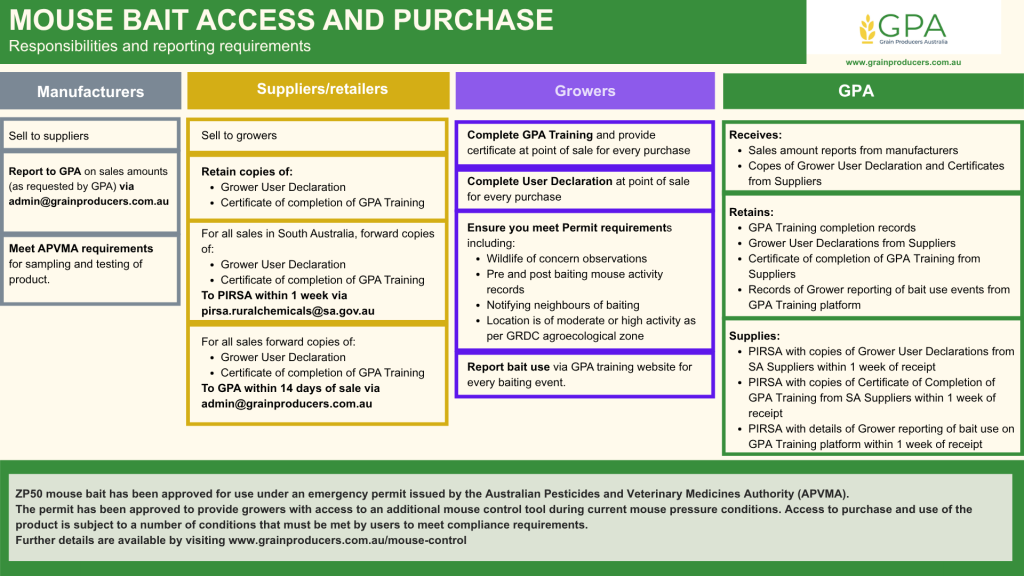
This fact sheet provides an overview of the emergency permit allowing limited use of double-strength 50 g/kg zinc phosphide baits under strict conditions, in response to high mouse activity (ZnP50 emergency permit). Manufacturers, suppliers and users must refer to the full permit (PER97414) setting out all conditions rather than relying on this fact sheet.
What is the APVMA and what do we do?
The Australian Pesticides and Veterinary Medicines Authority (APVMA) regulates agricultural and veterinary chemicals to protect the Australian community, wildlife and the environment. We set out permit conditions that must be followed to ensure that agvet chemicals can be used safely. One of the reasons we do this is to support farmers.
We work closely with state and territory control-of-use authorities to ensure that permit conditions are appropriate and enforceable. For the ZnP50 permit, despite a very tight timeframe, we conducted 2 rounds of consultation with all states before approving the permit.
The ZnP50 emergency permit was granted on 18 May 2026, following the APVMA’s assessment that use in accordance with permit conditions would meet the statutory safety, trade and efficacy criteria.
What does the permit allow?
On 25 April 2026, Grain Producers Australia (GPA) applied for the ZnP50 emergency permit. The application cited the extremely high mouse numbers in some regions of Australia and the onset of the crop planting season as evidence that an emergency permit was required.
The emergency permit allows use of ZnP50 where BOTH of the following criteria are met:
- The property is within an agroecological zone of moderate or higher mouse activity. The Grains Research & Development Corporation (GRDC) mouse management website defines these regions based on fortnightly monitoring.
- The property has high mouse activity, based on mouse population monitoring at that location. This is defined as at least 20 squares per chew card eaten, or active burrow counts show greater than 2 mouse holes / 100 m2. Refer to GRDC Factsheet Tips and Tactics Better Mouse Management for more information on monitoring mouse numbers.
Standard-strength (25g/kg) zinc phosphide bait is available and suitable for baiting at lower mouse activity.
Key conditions users must follow
In addition to the triggers set out above, use is tightly controlled.
- The product is restricted to trained users who must complete GPA training before purchasing the bait.
- To protect workers from this dangerous Schedule 7 poison, workers must wear personal protective equipment including a full-face respirator.
- To protect wildlife and the environment, a range of protections are required including low density baiting into stubble or other vegetation, buffer zones, a limit of 2 treatments, and requirements not to bait where listed threatened species are observed.
- Users must keep records of use, monitoring and any issues observed.
- Suppliers must only supply to appropriate users and must report sales.
- Any adverse impacts, including wildlife deaths, must be reported through the APVMA Adverse Experience Reporting system.
These requirements ensure the risks of the product can be safely managed and support monitoring of compliance with the conditions of the emergency permit.
What has the APVMA assessed?
The APVMA assessed risks to the safety of people, wildlife and the environment, and considered if the product is effective and will not be a risk to trade.
Zinc phosphide is a Schedule 7 poison with high acute oral toxicity but low dermal toxicity. Risks to users are mitigated through strict controls, including use of personal protective equipment. The higher concentration bait does not significantly increase worker health risk compared with registered products. Exposure to the public is expected to be minimal due to restricted access and use patterns.
Zinc phosphide is a non-specific vertebrate poison and has high toxicity to birds, mammals and some aquatic organisms. The most significant risks are primary poisoning of native rodents, pigeons, doves, cockatoos and rails. These risks are mitigated through a suite of permit conditions, including restrictions on application rates, maintenance of ground cover, buffer zones from native vegetation, and limitations on timing and frequency of application. Applying only where there is high mouse activity means there will be high bait uptake, further reducing exposure to non-target wildlife.
There is limited evidence of the circumstances where the higher concentration bait provides improved control compared with existing registered products. Limiting application to areas with high mouse activity ensures that the double-strength 50 g/kg product is not used where the regular registered 25 g/kg product will be sufficiently effective.
Residue and trade risks are considered low, as use according to the ZnP50 emergency permit directions is not expected to result in detectable residues in food or feed commodities.
Where to get more information
Growers should read the permit conditions carefully before use and follow all directions exactly. The ZnP50 emergency permit (PER97414) is available on the APVMA website and additional information is available through GRDC or GPA.